Monday, November 18, 2013
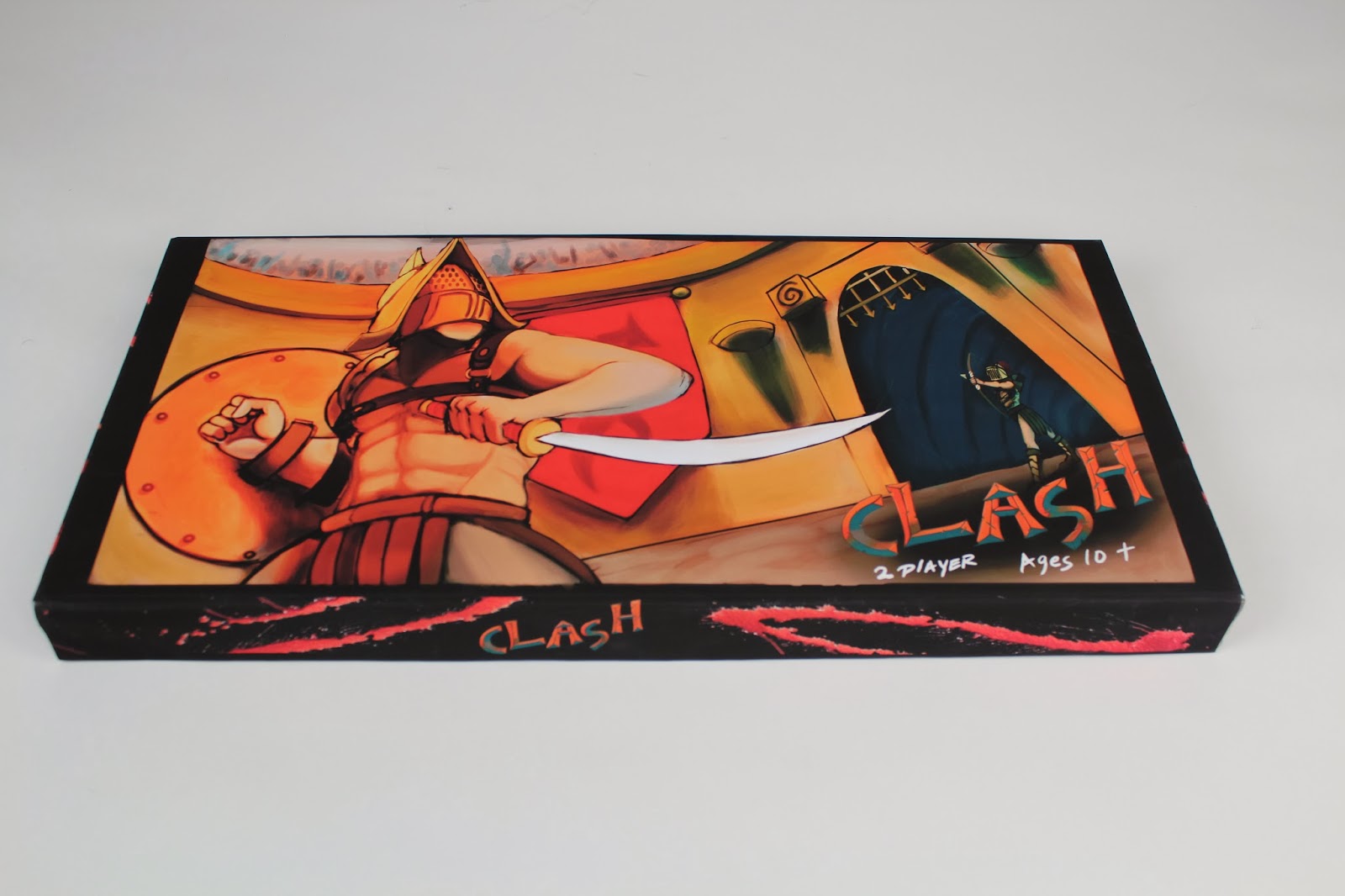
Clash! Board game pictures
For the final part of the Print and Play assignment we had to create an actual board game out of our print and play games! the following is Clash's physical version!
Monday, November 11, 2013
CLASH! Board Game
The Print and Play sensation that is sweeping the nation is now a blue and true Board Game!
Clash! the board game comes with:
One Arena Board
One Six Sided Dice
Two Player Mats
Two Health Strips
40 Attack Cards
15 Block Pieces
And two Player Pieces
And Hours on Hours of FUN!
Thursday, October 31, 2013
CLASH! A game of Wit and movement!
CLASH!! Is finished!
Link to PDF below!
https://drive.google.com/file/d/0B_jzGFnplzK7b01WQ1ViREJCTlE/edit?usp=sharing
Link to PDF below!
https://drive.google.com/file/d/0B_jzGFnplzK7b01WQ1ViREJCTlE/edit?usp=sharing
Thursday, October 10, 2013
Stress-Fight Rules (Alpha Stage)
More Exploration of the Game we are creating for Game Design:
STRESS REWARD/PUNISHMENT GAME MECHANICS:
RULES:
Both Players have A Character Card and an Attack Card:
A Character Card has several components:
- Character Name
- Character Illustration
- Health Points
- Stress State
An Attack Card has:
- Character Name (For association)
- Character Attacks (9 listed normal attacks with AP (Attack Points)
- Super Move Attack
The Rules are as follows:
- Each Player will take their turn during a round
- Each round is 5 seconds long.
- Players flip a coin to find out who goes during that round
- Player MUST play at least 3 moves out of the 10 they have.
- IF player does not play 3 moves within 5 seconds, characters become STRESSED
- After 3 rounds, characters unlock their SUPER-MOVE.
- if SUPER-MOVE is used, characters immediately become stressed, and end their turn.
- Each Character Card has a STRESS-STATE, all with penalties and bonuses that affect the game and characters.
- The goal is to survive the fight, and eliminate the other player's character.
For now, that's it, but it will continue with Character Card and Attack Card Layouts.
Monday, October 7, 2013
Theme
For more exploration of our soon-to-be-ready print-play-games, we have taken a look at Themes, and how they work within game design, as well as our own games. We have been asked to choose our own themes, and thus, this will be my exploration of my Theme.
Fight to the top in Character-Driven fast action battles.
To describe this theme is simple. The goal is to create aesthetically attractive, thematic characters that can attract players into using them, to battle other players and see who can use the best of their allotted time to win matches between the two opposing players. The best way to describe this is as an actual battle simulation, taking many different properties into account, skill, time, and sheer luck to get in the correct blow at the correct time. It is Gladiator-Style Combat.
Research: Gladiator-Style Fighting
The movie Gladiator is a great example of what I want to exemplify within the game, combining great action scenes with interesting characters, allowing for an experience that mystifies it's audience and creates a great story. While I myself will not be going for an expanded story, the characters will be a large part of the game being made, and will be needing to be aesthetically pleasing for players to choose them.
Some more Gladiator Stuff:
Color Scheme:
The goal of the color scheme is to have a large collection of oranges and browns, with several accent colors to allow important areas within the cards of the game to be shown. The character card artworks will have their own color schemes, keeping them separate to disallow confusion.
Thursday, October 3, 2013
Brainstorming!
Coming up with a game idea is hard; So much goes into simply thinking about an idea, and no idea is guaranteed to work. Things that have to be taken into account is balance, skill, time, along with many other intermittent factors that can hardly be predicted until the game is play-tested. Still, the first step to creating a good game is to think up of something, or anything rather, that can become a good game.
With that comes inspiration. For my idea of a game, I want to look at time, skill, and balance, things that are essential within a good, fast-paced table-top game. Because of this, I've taken the time out to play several different games, with these things in mind.
Operation is a great, fast-paced skill game which, while iconic, has some core features in the aspects of game design that can be greatly relied upon when making games. It's fast pace, it's careful handling, and force of though-processing through the play time is something that I definitely want to mirror within my game. It's also a personal philosophy, that fast games can be the most fun when designed right.
Magic the gathering allows for more patience, as well as balance. The game takes balance to new heights in fact, having several different types of cards come out every year, and different rotations and rules circulated for different play-types, all using the same, constant cards. This game oozes balance, and gives players tons of way to use that balance and skill to their advantage. The game can go fast, or slow depending on the cards that are played, but no matter what, it is always in some way, balanced.
Dungeons and Dragons. What else is there to say? The story arcs, the skill, the rich stories that can come out of this game- It is simply staggering, and one I take complete joy in playing every single week. While it is a heavy game, I don't want too heavily rely on using this game for inspiration. It's simply a game who's rich story and character I want to emulate, and nothing more.
Without further ado, let's move on to some game ideas.
While many of these will be simply brainstorming, I have one idea which I'm very very excited about doing.
This game would be a card game: Two players fighting against one another in a one v. one match to kill the other player, with attacks going on each round. The rules would go like this.
Another idea was to take a DND type approach, and streamline it for simple campaigns, that are 10-20 minutes, with some sort of buildable dungeons that a "dungeon Master" can build before hand. Using Tiles. and Monster Pieces.
Another game would be to create different puzzles for players to use, and throw around at each other, the one who solves it first being the one who wins.
Another could be players taking the roles of hunters, while other players become prey, and the players have to guess which one is which.
A player could be a "killer" while the others could be investigators, like in the game clue, but each player could be picked off by the "killer" player one by one.
Players could negotiate the death of a nation, with a game about bombs, where they would have to stratergize where the bombs go within a certain amount of time, and try to cause the least, or most amount of damage done to a population.
Players could do their best to race to the finish in a racing game, using different, wild effects to throw players back or forward in the map.
Players could roll dice to see who is able to take down a large monster, using different, plastic rods that they take out one turn at a time.
Players could explore an underwater ruin, with cards going off every few rounds as they explore to activate different things that could happen within the game.
Players could also do the same thing, but go through a large, mayan ziggurat.
Players could also use resources to create walls as they defend a large palace from invaders.
Players could see how long they could survive while going through a lovecraftian maze, being followed by different horrors.
They could also play a non-sensical game that allows you to play random, different effecting cards every turn that would cause the game to go through hundreds of different things.
With that comes inspiration. For my idea of a game, I want to look at time, skill, and balance, things that are essential within a good, fast-paced table-top game. Because of this, I've taken the time out to play several different games, with these things in mind.
Operation is a great, fast-paced skill game which, while iconic, has some core features in the aspects of game design that can be greatly relied upon when making games. It's fast pace, it's careful handling, and force of though-processing through the play time is something that I definitely want to mirror within my game. It's also a personal philosophy, that fast games can be the most fun when designed right.
Magic the gathering allows for more patience, as well as balance. The game takes balance to new heights in fact, having several different types of cards come out every year, and different rotations and rules circulated for different play-types, all using the same, constant cards. This game oozes balance, and gives players tons of way to use that balance and skill to their advantage. The game can go fast, or slow depending on the cards that are played, but no matter what, it is always in some way, balanced.
Dungeons and Dragons. What else is there to say? The story arcs, the skill, the rich stories that can come out of this game- It is simply staggering, and one I take complete joy in playing every single week. While it is a heavy game, I don't want too heavily rely on using this game for inspiration. It's simply a game who's rich story and character I want to emulate, and nothing more.
Without further ado, let's move on to some game ideas.
While many of these will be simply brainstorming, I have one idea which I'm very very excited about doing.
This game would be a card game: Two players fighting against one another in a one v. one match to kill the other player, with attacks going on each round. The rules would go like this.
- Each round would be 5 seconds long, with players flipping a coin to see who goes that round.
- Each character has 10 moves, and MUST play at least 3 moves.
- If player does not play 3 moves within 5 seconds, the character they control becomes stressed.
- Each character has a stress-state (which lasts one round), all with penalties and bonuses. (Exp. +2 attack, -2 health)
- After 3 rounds, characters unlock a Super Move.
- If Super Move is used, character auto-stresses. This will end their turn.
- The goal is to survive the fight, and eliminate the other player's character.
Another idea was to take a DND type approach, and streamline it for simple campaigns, that are 10-20 minutes, with some sort of buildable dungeons that a "dungeon Master" can build before hand. Using Tiles. and Monster Pieces.
Another game would be to create different puzzles for players to use, and throw around at each other, the one who solves it first being the one who wins.
Another could be players taking the roles of hunters, while other players become prey, and the players have to guess which one is which.
A player could be a "killer" while the others could be investigators, like in the game clue, but each player could be picked off by the "killer" player one by one.
Players could negotiate the death of a nation, with a game about bombs, where they would have to stratergize where the bombs go within a certain amount of time, and try to cause the least, or most amount of damage done to a population.
Players could do their best to race to the finish in a racing game, using different, wild effects to throw players back or forward in the map.
Players could roll dice to see who is able to take down a large monster, using different, plastic rods that they take out one turn at a time.
Players could explore an underwater ruin, with cards going off every few rounds as they explore to activate different things that could happen within the game.
Players could also do the same thing, but go through a large, mayan ziggurat.
Players could also use resources to create walls as they defend a large palace from invaders.
Players could see how long they could survive while going through a lovecraftian maze, being followed by different horrors.
They could also play a non-sensical game that allows you to play random, different effecting cards every turn that would cause the game to go through hundreds of different things.
Monday, September 30, 2013
Print and Play Game Breakdown: Space Junkyard!
During our time looking at and experimenting with different games, several of which I have yet to post on this blog, we got a chance to look at and deconstruct our favorite games that we played.
For me, that game happened to Be Space Junkyard!
Game Objective and Win State:
The Goal of the game is simple, Collect as many parts for your ship as possible, faster than any of your other opponents. The only way to win is to have more victory points than your opponents! This can only be achieved by getting as many pieces as possible, though just because one has more pieces does not necessarily mean that they will have more points.
Mechanics:
The game's mechanics, unlike it's goal and win-state, are not so simple.
The whole game is based around resource: 3 different types of material that can be used as currency within the game to allow ship-parts to be attached to the main ships of each player, to allow for more victory points! (VP)
The three types of materials are:
Players start on each corner of the map, which is a 6x6 grid, created out of the supplied, and upside down, cards- all of which have their own specific and unique amount of asteroids and ships-parts with VP.
Players can move around the space of the game, or the map, 3 spaces at a time, in any direction they want as long as it is not diagonal. Players cannot move onto spaces that other players occupy, and must move around them or past them to continue. This opens up many different strategies for players to use in movement, while also making sure that they can always reach a floating piece of space-junk within the 6x6 square. Space junk can be either Asteroids, which have certain amount of materials corresponding to their colors, or VP-giving ship-parts.
After movement, the player has two options: Storing or Recycling.
Players themselves learn resource management, and strategic placement and movement. During our play session, players were forcing themselves out of the game space so that they could put themselves into more strategic areas, thanks to the placement rule on players going out-of-bounds. Players would also do their best to collect as much resources as possible, and sacrificing when needed to be able to gain as much VP as possible.
The game itself has a problem with chance. The cards that are placed upside-down to create the 6x6 grid are all randomized and shuffled before hand, making the cards players land on completely random. This has players finding great VP giving parts early, when they have little resources, and low VP parts later on, when they finally do have the materials they need.
While simple at first, the mechanics of the game are very complex, and made the game seem to go on longer in time then it actually did. It also frustrated the players with the reliance on chance the game had, making it very hard to actually attain VP within the allotted time. Overall though, the game was fun and a good experience for those of us who played it.
For me, that game happened to Be Space Junkyard!
Game Objective and Win State:
The Goal of the game is simple, Collect as many parts for your ship as possible, faster than any of your other opponents. The only way to win is to have more victory points than your opponents! This can only be achieved by getting as many pieces as possible, though just because one has more pieces does not necessarily mean that they will have more points.
Mechanics:
The game's mechanics, unlike it's goal and win-state, are not so simple.
The whole game is based around resource: 3 different types of material that can be used as currency within the game to allow ship-parts to be attached to the main ships of each player, to allow for more victory points! (VP)
The three types of materials are:
- Radioactive
- Mechanic
- and Scrap-Metal
Gaining materials is tricky. Players all gain a Radioactive material at the beginning of the game, and use it as they continue, storing it within their ship, and spending it when necessary. Though the three are distinct, there is not much of a reason for their names outside of decoration. All they are used for is as currency to allow you to connect ship-parts, and gain VP.
Players start on each corner of the map, which is a 6x6 grid, created out of the supplied, and upside down, cards- all of which have their own specific and unique amount of asteroids and ships-parts with VP.
Players can move around the space of the game, or the map, 3 spaces at a time, in any direction they want as long as it is not diagonal. Players cannot move onto spaces that other players occupy, and must move around them or past them to continue. This opens up many different strategies for players to use in movement, while also making sure that they can always reach a floating piece of space-junk within the 6x6 square. Space junk can be either Asteroids, which have certain amount of materials corresponding to their colors, or VP-giving ship-parts.
After movement, the player has two options: Storing or Recycling.
- Storing allows players to take the junk(or ship parts) they find within the grid, and take it, connecting it to their ships to allow for them to attain VP. To attain it, the must have the necessary combination of resources to allow for the ship to remain connected. If they do not have the material, they must recycle the ship-part.
- Recycling is the most common, and trickiest of plays within the game. When players do not have enough materials, as they often do not, ship parts they encounter must be recycled. Once it is recycled, it is removed from play, and the resources that are available from the ship-part, are given to the player. This also applies to Storing cards.
This is a problem thanks to the way the ships are set up. Ships can only store a certain amount of materials within them. To hold more materials, you must attain more ships, and to attain more ships, you must have the necessary materials. It quickly becomes a game of spending, as players frivolously spend their resources when they can, or find themselves throwing a perfectly good ship part away, for resources they already have, and cannot carry more of.
After using a card, and taking whatever is on it (whether ship part or asteroid) Players can then finish their turn by placing a card from the pile of extra cards that the game provides, moving the 6x6 square's lines about, shooting players and cards off the game space. Cards that are "lost" within this movement are thrown out of the game, not to be used for the rest of it, while players are returned on whatever card they choose, on the side they were thrown out.
Players themselves learn resource management, and strategic placement and movement. During our play session, players were forcing themselves out of the game space so that they could put themselves into more strategic areas, thanks to the placement rule on players going out-of-bounds. Players would also do their best to collect as much resources as possible, and sacrificing when needed to be able to gain as much VP as possible.
The game itself has a problem with chance. The cards that are placed upside-down to create the 6x6 grid are all randomized and shuffled before hand, making the cards players land on completely random. This has players finding great VP giving parts early, when they have little resources, and low VP parts later on, when they finally do have the materials they need.
While simple at first, the mechanics of the game are very complex, and made the game seem to go on longer in time then it actually did. It also frustrated the players with the reliance on chance the game had, making it very hard to actually attain VP within the allotted time. Overall though, the game was fun and a good experience for those of us who played it.
Subscribe to:
Posts (Atom)